

Punjab School Education Department Summer Camp Notification 2026: Official Guidelines, Rules, and Complete Details
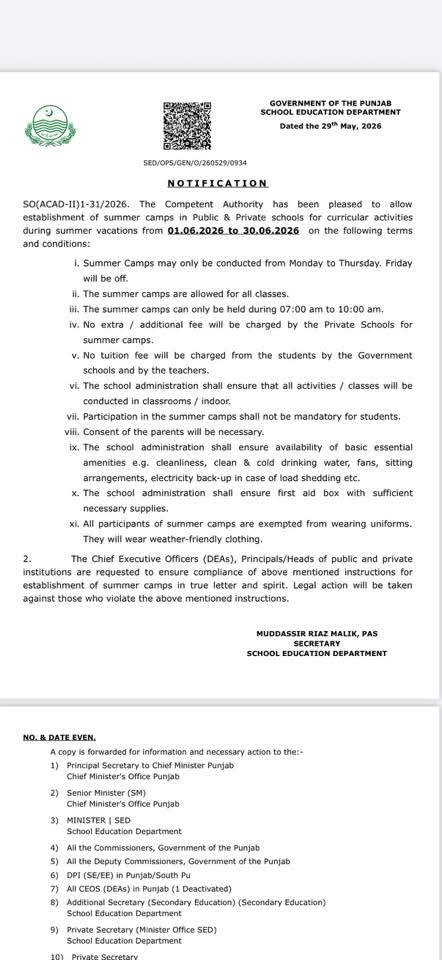
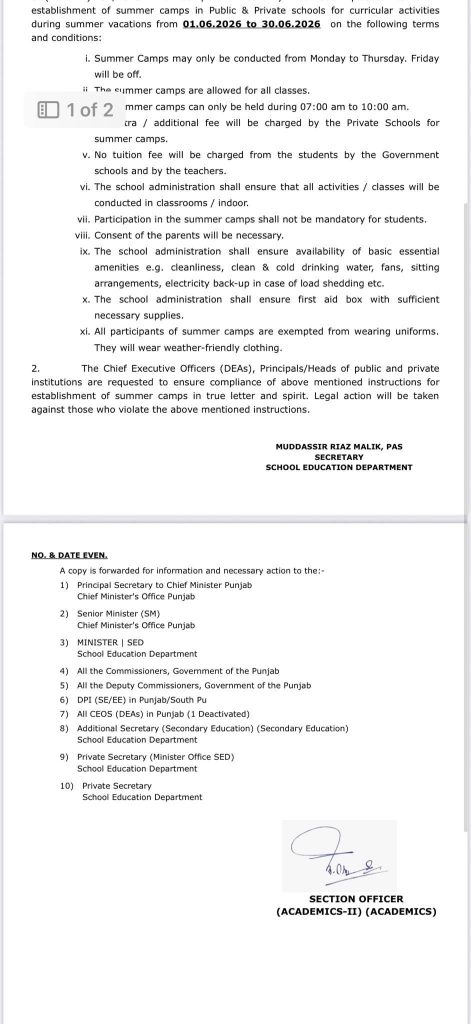
The Government of the Punjab, School Education Department (SED), has officially issued a notification regarding the establishment of summer camps in both public and private schools across the province. Dated May 29, 2026, this notification (Ref No. SO(ACAD-II)1-31/2026) outlines comprehensive guidelines, standard operating procedures (SOPs), and strict terms and conditions for conducting curricular activities during the upcoming summer vacations.
As the summer heat intensifies across Pakistan, the provincial government has taken a balanced approach. While schools are closing for regular classes, the provision for summer camps from June 1, 2026, to June 30, 2026, ensures that students can engage in productive curricular activities without compromising their health, safety, or their parents’ finances.
In this detailed article, we provide an in-depth analysis of the official notification, breaking down every rule, the reasoning behind it, and what it means for students, parents, and school administrations across Punjab.
Overview of the 2026 Summer Camp Notification
According to the official circular signed by Muddassir Riaz Malik (PAS), Secretary of the School Education Department, the competent authority has allowed the establishment of summer camps for curricular activities. However, this permission is strictly conditional. All District Education Authorities (DEAs), school principals, and administrative heads must adhere strictly to the 11-point terms and conditions listed in the document.
The primary objective of these rules is to facilitate continued learning and student engagement while protecting children from the severe summer heatwaves typical of the region during June.
Key Highlights of the Summer Camp Rules
To give you a quick summary before we dive into the detailed breakdown, here are the most crucial takeaways from the official notification:
- Duration: June 1, 2026, to June 30, 2026.
- Operating Days: Monday to Thursday (Fridays are strictly off).
- Timings: 07:00 AM to 10:00 AM only.
- Target Audience: Allowed for all classes.
- Fee Policy: Absolutely NO extra or additional fee can be charged by private or public schools.
- Attendance: Not mandatory; entirely dependent on parental consent.
- Dress Code: No uniforms required; students can wear weather-friendly clothing.
- Safety Protocols: Indoor activities only, mandatory cold drinking water, electricity backup, and first-aid kits.
Detailed Breakdown of Terms and Conditions
The School Education Department has meticulously drafted the terms and conditions to ensure that no child is exploited, physically stressed, or financially burdened. Let’s analyze each condition laid out in the official notification.
1. Schedule and Timings (Protecting Students from Heat)
- Working Days: The notification clearly states, “Summer Camps may only be conducted from Monday to Thursday. Friday will be off.” This four-day-a-week schedule gives students a long three-day weekend to rest and recover, ensuring they do not experience burnout during their vacation time.
- Restricted Timings: Rule number three mandates that “The summer camps can only be held during 07:00 am to 10:00 am.” By restricting the camp to just three morning hours, the government is ensuring that students are safely back home before the peak heat hours of the day (11:00 AM to 4:00 PM).
- Inclusivity: The camps are “allowed for all classes,” meaning schools can arrange curricular catch-up or enrichment programs for primary, middle, and high school students alike.
2. Strict Fee Policies (Financial Relief for Parents)
Historically, private schools have used summer camps as a loophole to generate additional revenue during the vacation months. The 2026 notification completely shuts down this practice.
- Private Schools: Rule four dictates: “No extra / additional fee will be charged by the Private Schools for summer camps.” Private institutions cannot demand a separate “summer camp fee” or “activity fee” from parents.
- Public Schools: Similarly, rule five states: “No tuition fee will be charged from the students by the Government schools and by the teachers.” This ensures that public education remains free and accessible, preventing any rogue elements from exploiting students.
3. Health, Safety, and Infrastructure Requirements
The most critical aspect of the notification revolves around student well-being during the harsh summer weather. The SED has placed heavy responsibility on school administrations to guarantee a safe environment.
- Indoor Activities Only: Rule six mandates that “all activities / classes will be conducted in classrooms / indoor.” Outdoor sports, morning assemblies under the sun, or playground activities are strictly banned to prevent heatstroke and dehydration.
- Essential Amenities and Power Backup: According to rule nine, schools must ensure the availability of basic amenities. This includes “cleanliness, clean & cold drinking water, fans, sitting arrangements, electricity back-up in case of load shedding etc.” The mention of power backup is highly significant. With load shedding being a reality in many parts of Punjab, schools without generators or UPS systems are technically not permitted to host these camps.
- First Aid Readiness: Rule ten states, “The school administration shall ensure first aid box with sufficient necessary supplies.” In the event of a student feeling unwell, faint, or dehydrated, schools must have the necessary medical supplies on hand to provide immediate relief.
4. Dress Code Exemption
In a highly appreciated move, rule eleven brings relief to students regarding their attire: “All participants of summer camps are exempted from wearing uniforms. They will wear weather-friendly clothing.” School uniforms, often made of heavy fabrics or requiring ties and closed shoes, are not suitable for June weather. Allowing light, breathable, and comfortable civil clothes will significantly improve the students’ comfort levels.
5. Voluntary Participation and Parental Consent
The government has made it abundantly clear that these summer camps are not compulsory.
- Rule seven explicitly notes: “Participation in the summer camps shall not be mandatory for students.” * Rule eight reinforces this by stating: “Consent of the parents will be necessary.” Schools cannot penalize students for not attending the summer camp. There can be no deduction of marks, nor can attendance be made a prerequisite for the upcoming academic term. Parents have the ultimate authority to decide whether they want to send their children to the camp.
Directives for School Administrations and Authorities
The notification concludes with a stern warning and a call to action for educational authorities across the province.
The document states: “The Chief Executive Officers (DEAs), Principals/Heads of public and private institutions are requested to ensure compliance of above mentioned instructions for establishment of summer camps in true letter and spirit. Legal action will be taken against those who violate the above mentioned instructions.”
What Does This Mean for Schools?
- Strict Monitoring: District Education Authorities (DEAs) will likely form monitoring committees or conduct surprise visits to ensure compliance.
- Zero Tolerance on Fees: If a private school is found distributing fee challans for the summer camp, parents can report them to the relevant DEA, resulting in severe penalties, fines, or even the cancellation of the school’s registration.
- Mandatory Power Backup: Schools that rely entirely on the main power grid and suffer from power outages during the 7:00 AM to 10:00 AM window will face legal action if they force students to sit in unventilated, hot classrooms.
The Role of the Government and CC Notifications
To ensure wide-scale implementation, a copy of this notification has been forwarded to the highest offices in the province. The document signed by the Section Officer (Academics-II) lists the following recipients:
- Principal Secretary to Chief Minister Punjab
- Senior Minister (SM), Chief Minister’s Office Punjab
- Minister, School Education Department
- All Commissioners, Government of the Punjab
- All Deputy Commissioners (DCs), Government of the Punjab
- DPI (SE/EE) in Punjab/South Punjab
- All CEOs (DEAs) in Punjab
- Additional Secretary (Secondary Education)
- Private Secretaries to the Minister and Secretary of SED.
The involvement of Deputy Commissioners and Commissioners indicates that the district administration will actively support the education department in enforcing these SOPs.
Why This Notification is a Masterclass in Student Welfare
The May 29, 2026 notification by the Punjab School Education Department is being widely praised by parents and educational experts for its comprehensive and empathetic approach. Here is why this notification stands out:
- Combating the Heatwave: Pakistan is highly vulnerable to climate change, and June temperatures in Punjab frequently cross 40°C (104°F). By limiting hours to the early morning and banning outdoor activities, the government has prioritized children’s lives over rigorous academic schedules.
- Ending Financial Exploitation: The middle class is already facing immense economic pressure. By banning additional fees, the government has ensured that private schools cannot monetize the summer break.
- Mental Health and Burnout: By making attendance voluntary and giving three days off (Friday to Sunday), the SED is acknowledging the importance of rest. Summer vacations are meant for unwinding, and forced academic rigor during this time can lead to severe student burnout.
- Flexibility in Clothing: The suspension of the uniform policy is a practical and highly necessary step for physical comfort.
What Parents Should Do Next?
If you are a parent of a student enrolled in a public or private school in Punjab, here is an actionable guide based on this official notification:
- Evaluate Your Child’s Needs: Decide if your child actually needs to attend the curricular summer camp. If they are up-to-date with their studies, it might be better to let them rest at home.
- Do Not Pay Extra Fees: If your child’s private school issues a fee voucher specifically for the summer camp, refuse to pay it and cite the SED Notification SO(ACAD-II)1-31/2026. You can file a complaint with the Deputy Commissioner’s office or the local CEO of the DEA.
- Check School Facilities: Before sending your child, visit the school to ensure they have an active generator or UPS, as well as a supply of clean, cold drinking water. If these are missing, do not send your child.
- Sign the Consent Form Carefully: Since your consent is mandatory, ensure you provide written consent only if you are fully satisfied with the school’s arrangements.
- Dress Your Child Appropriately: Take advantage of the uniform exemption. Dress your child in light-colored, loose-fitting cotton clothes to keep them cool.
Frequently Asked Questions (FAQs)
To further clarify the official notification, here are some commonly asked questions:
Q1: Are summer camps mandatory for all students in Punjab? Answer: No. According to point (vii) of the official notification, participation is strictly voluntary and not mandatory for any student.
Q2: Can a private school charge a summer camp fee? Answer: Absolutely not. Point (iv) explicitly states that no extra or additional fee will be charged by private schools for summer camps. Legal action will be taken against schools that violate this rule.
Q3: What are the allowed timings for summer camps in 2026? Answer: Summer camps can only be held between 07:00 AM and 10:00 AM, from Monday to Thursday. Fridays are officially off.
Q4: Do students have to wear uniforms during the summer camp? Answer: No. Point (xi) exempts all participants from wearing school uniforms. Students are encouraged to wear weather-friendly, comfortable clothing.
Q5: What happens if a school holds outdoor sports classes during the camp? Answer: This is a direct violation of the SED notification. Point (vi) mandates that all activities and classes must be conducted indoors or within classrooms. Parents can report such violations to the DEA.
Q6: What dates are the summer camps allowed to operate? Answer: The competent authority has permitted the establishment of these camps strictly between June 1, 2026, and June 30, 2026.
Conclusion
The Government of the Punjab, School Education Department has set a highly commendable precedent with its latest notification regarding summer camps for 2026. By balancing the need for educational continuity with strict health, safety, and financial regulations, Secretary Muddassir Riaz Malik and his department have safeguarded the interests of students and parents alike.
School administrations must now take this notification seriously. The warning of legal action is clear, and with the involvement of district administrations, compliance will be heavily monitored. Parents are encouraged to stay informed of their rights under this notification, ensuring their children enjoy a safe, productive, and stress-free summer vacation.