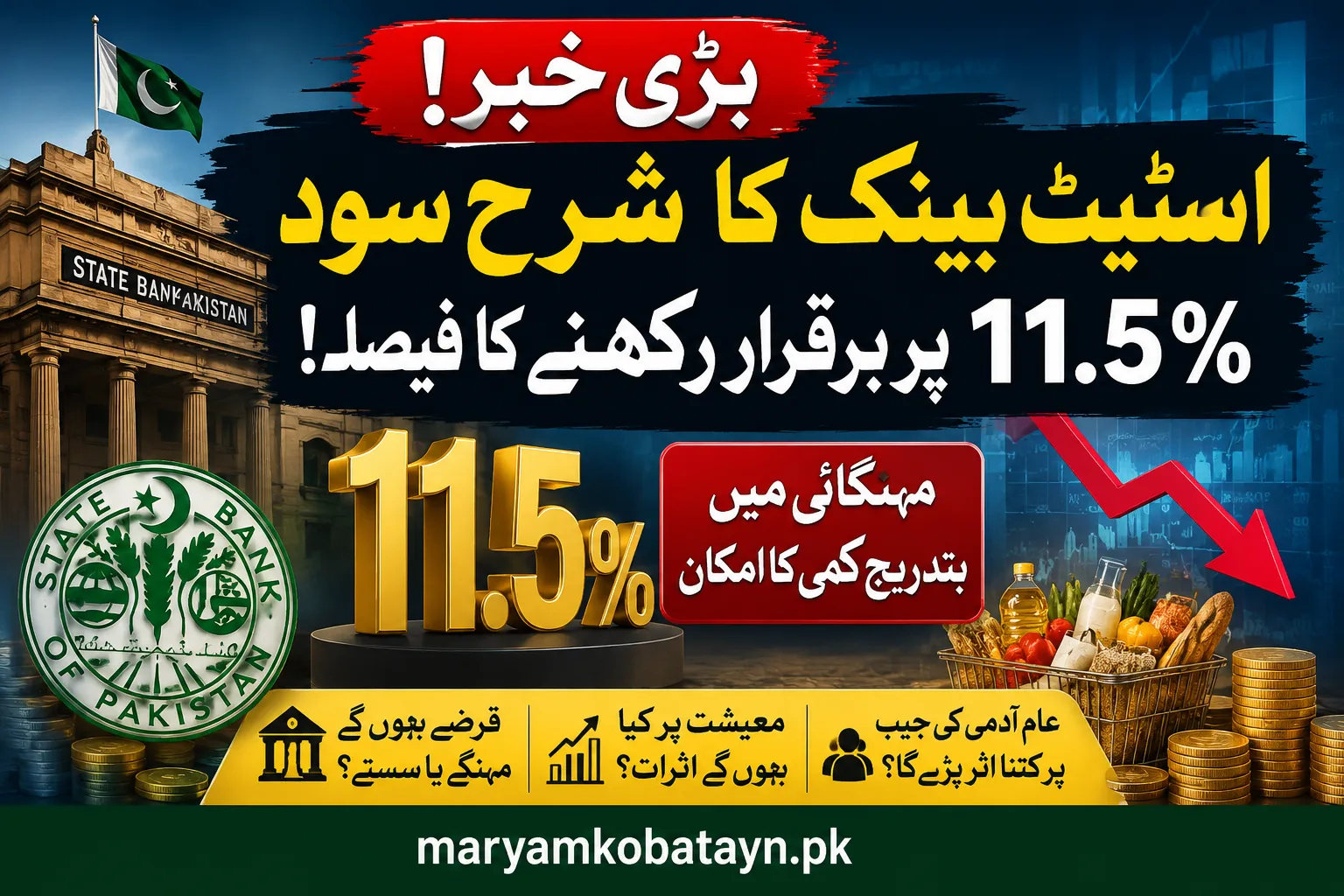
Pakistan’s Interest Rate Stays at 11.5% — Here’s What It Means for Inflation, Loans, and Your Money
The State Bank of Pakistan has kept its policy rate unchanged at 11.5%. Discover why the decision was made, what rising inflation means, and how it could impact loans, businesses, investments, and the economy in 2026.
State Bank Keeps Interest Rate at 11.5%: What It Means for Pakistan’s Economy, Inflation, and Your Finances
Pakistan’s central bank has made one of its most closely watched economic decisions of the year. The State Bank of Pakistan (SBP) announced that it will keep the benchmark interest rate unchanged at 11.5%, choosing caution over an immediate rate cut despite expectations from some market participants.
The decision comes at a critical time when inflation has started rising again after months of moderation. According to the latest figures, inflation increased from 7.3% in March to 10.9% in April and further accelerated to 11.7% in May. These numbers have raised concerns among policymakers who fear that cutting interest rates too soon could reignite broader inflationary pressures across the economy.
For millions of Pakistanis, this decision affects much more than economic headlines. Interest rates influence loan costs, business expansion plans, investment decisions, savings returns, consumer spending, and even the value of the Pakistani rupee.
So why did the State Bank decide to keep rates unchanged? What does this mean for inflation? And when can Pakistanis expect borrowing costs to fall again?
Let’s break it down.
Why the State Bank Decided to Hold Rates at 11.5%
Central banks use interest rates as one of their most powerful tools to control inflation and maintain economic stability. When inflation rises too quickly, policymakers often keep rates elevated to reduce excess demand and prevent prices from spiraling higher.
The latest inflation data appears to have played a major role in the SBP’s decision.
After falling significantly earlier in the year, inflation has once again moved into double digits. This unexpected increase suggests that underlying price pressures remain stronger than previously anticipated.
By maintaining the policy rate at 11.5%, the central bank is signaling that controlling inflation remains its top priority. Officials believe that a premature rate cut could undermine progress made in stabilizing prices over the past year.
The move also reflects ongoing uncertainty surrounding global commodity prices, energy costs, fiscal adjustments, and external economic risks.
Inflation Is Rising Again — Should Pakistanis Be Worried?
Inflation remains one of the biggest challenges facing Pakistan’s economy.
When inflation rises, consumers lose purchasing power because goods and services become more expensive. Households must spend more on food, transportation, utilities, education, and healthcare.
Recent inflation figures show a clear upward trend:
- March 2026: 7.3%
- April 2026: 10.9%
- May 2026: 11.7%
While these levels are still significantly lower than the peak inflation rates seen in previous years, the latest increase has prompted concerns that price pressures may persist longer than expected.
The State Bank expects inflation to remain in double digits for the next few months before gradually easing later in the year.
This means consumers may continue facing higher living costs in the short term, particularly for essential goods and energy-related expenses.
What Happens to Bank Loans Now?
One of the most immediate effects of the policy rate decision will be felt by borrowers.
Since the benchmark rate remains unchanged, commercial banks are unlikely to make significant reductions in lending rates in the near future.
This affects:
Home Loans
People planning to buy homes through bank financing may not see major reductions in monthly installments.
Auto Financing
Car financing costs are expected to remain relatively stable, limiting affordability improvements for potential buyers.
Business Loans
Companies looking to expand operations or invest in new projects may continue facing elevated borrowing costs.
Personal Loans
Consumers seeking personal financing could also experience little change in interest charges.
For borrowers hoping for a rapid decline in financing costs, the latest decision means they may need to wait longer for meaningful relief.
Impact on Businesses and Investors
Businesses closely monitor interest rate decisions because borrowing costs directly affect profitability and expansion plans.
Higher rates generally make financing more expensive, causing some firms to delay investments or reduce capital expenditures.
However, there is another side to the story.
Stable interest rates can create confidence in the broader economy by demonstrating that policymakers are committed to controlling inflation. Investors often prefer predictable monetary policies because they reduce uncertainty.
For stock market participants, the decision sends a mixed signal. While lower rates typically support equity markets, inflation control and macroeconomic stability can also improve investor sentiment over the long run.
What Does This Mean for Savings Accounts and Deposits?
For savers, the decision may be viewed more positively.
Higher interest rates generally support better returns on savings accounts, fixed deposits, and certain income-generating financial products.
Many households that shifted money into banking products during the period of elevated interest rates may continue benefiting from relatively attractive returns compared to periods of lower rates.
However, the real benefit depends on inflation. If inflation rises faster than savings returns, purchasing power can still decline despite earning interest.
Pakistan’s Fiscal Position and Economic Outlook
Alongside the monetary policy announcement, attention has also focused on the government’s fiscal targets.
Despite a shortfall in revenue collection targets, authorities remain confident that expenditure controls will help achieve a primary surplus equivalent to 2.5% of GDP.
Achieving this goal would be important for maintaining macroeconomic stability, strengthening investor confidence, and supporting broader economic reforms.
Fiscal discipline combined with prudent monetary policy could help create conditions for sustainable growth while reducing inflationary pressures.
When Could Interest Rates Start Falling Again?
This is the question millions of Pakistanis are asking.
Future rate cuts will largely depend on inflation trends.
If inflation begins declining consistently over the coming months and remains within the central bank’s desired range, policymakers may gain room to gradually reduce borrowing costs.
Analysts will closely watch:
- Monthly inflation data
- Energy price movements
- Exchange rate stability
- Government fiscal performance
- Foreign exchange reserves
- Global economic conditions
A sustained decline in inflation could open the door for rate cuts later in the year, but any decision will depend on incoming economic data.
The Bottom Line
The State Bank of Pakistan’s decision to keep the policy rate unchanged at 11.5% highlights the balancing act facing policymakers in 2026. While economic activity would benefit from lower borrowing costs, rising inflation remains a significant concern.
For now, the central bank has chosen stability over stimulus.
Consumers should prepare for inflation to remain elevated in the near term, businesses may continue facing higher financing costs, and borrowers are unlikely to see immediate relief. However, if inflation gradually eases as expected, the possibility of future interest rate cuts could become a reality.
The coming months will be crucial in determining whether Pakistan’s economy can maintain stability, control inflation, and create conditions for sustainable growth without placing additional pressure on households and businesses.